Habit-Based Tools Like Habit Halo and the Role of Behavioral Design in Quitting Vaping

Habit-Based Tools Like Habit Halo and the Role of Behavioral Design in Quitting Vaping

Quit Smoking Resources
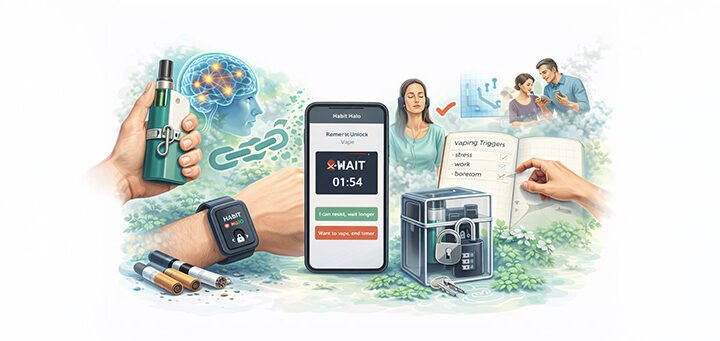
Breaking a vaping habit isn’t only about nicotine—it’s about behavior, repetition, and impulse. Platforms and tools like Habit Halo reflect a growing shift in cessation thinking: instead of relying solely on chemical substitutes, they focus on habit awareness, intentional pauses, and behavioral restructuring. This approach aligns with modern addiction science, which recognizes that automatic behaviors can persist even after nicotine dependence begins to fade. Why Habit Change Matters in Vaping Cessation Vaping differs from traditional smoking in critical ways: It allows continuous use rather than discrete sessions It removes social and physical limits It encourages unconscious, repetitive behavior It embeds itself into work, stress, and focus routines As a result, many people trying to quit vaping don’t fail because of intense cravings—but because of habit loops that fire before conscious…
Read More
Innovative Devices That Help People Quit Vaping: How Behavior-Based Tools Are Changing Cessation Support

Innovative Devices That Help People Quit Vaping: How Behavior-Based Tools Are Changing Cessation Support

Quit Smoking Resources
New approaches to vaping cessation are emerging that go beyond nicotine replacement and medications. One recent innovation—developed by a graduate associated with Indiana University—highlights a growing shift toward behavior-based devices designed to interrupt vaping habits, reduce impulsive use, and support people who want to quit. Rather than treating vaping solely as a chemical addiction, these tools recognize something critical: vaping is also a deeply ingrained behavioral loop. This article expands on that idea and places it within a broader, wellness-focused context that aligns with the mission of QuitSmokingCommunity.org—supporting informed, sustainable pathways away from nicotine dependence. Why Vaping Is So Hard to Quit Vaping combines nicotine addiction with high-frequency behavioral reinforcement. Unlike cigarettes, vapes: Are easy to conceal and use indoors Deliver nicotine smoothly, often without harsh cues Encourage constant, low-awareness…
Read More
I Found My Young Teen Son Vaping, What should I do?

I Found My Young Teen Son Vaping, What should I do?

Quit Smoking Resources
A Calm, Practical Guide for Parents Who Want to Act Early—and Effectively Discovering or suspecting that your 12-year-old is vaping can be alarming. Many parents feel a mix of fear, anger, confusion, and urgency—especially when vaping is often framed as “less harmful” or dismissed as a phase. But at this age, vaping is not harmless experimentation. It is early exposure to nicotine, habit formation, and emotional regulation through inhalation. This article is designed to help parents respond without panic, without shaming, and without repeating scare tactics that often backfire. Instead, it focuses on understanding why children vape, what actually helps them stop, and how to reduce the risk of long-term dependence—while preserving trust. First: Take a Breath Before You Act Your reaction matters more than the device itself. At 12…
Read More
New Year, Clear Lungs: How Carbon Monoxide Awareness Can Support Smoking Cessation

New Year, Clear Lungs: How Carbon Monoxide Awareness Can Support Smoking Cessation

Quit Smoking Resources
Every January, millions of people set a resolution to quit smoking. Motivation is usually high, intentions are sincere, and the desire for a healthier year feels real. Yet statistics consistently show that many quit attempts fade within weeks—not because people don’t care, but because progress is hard to see in the early stages. One emerging concept gaining attention in smoking cessation is carbon monoxide (CO) awareness and tracking. While quitting smoking has traditionally relied on willpower, counseling, and nicotine replacement, CO feedback introduces something many smokers lack during early recovery: immediate, objective proof that the body is healing. This article explores how carbon monoxide relates to smoking, why awareness matters, and how CO tracking can complement—not replace—evidence-based quitting strategies. The focus here is behavioral support and motivation, avoiding redundancy with…
Read More
If You Smoke Every Day, How Long Until You’re “Clean”?

If You Smoke Every Day, How Long Until You’re “Clean”?

Quit Smoking Resources
A Practical, Non-Redundant Look at Nicotine, THC, and Real Recovery People often ask how long it takes to be “clean” after smoking every day, but that question is usually asked without defining what “clean” actually means. On QuitSmokingCommunity.org, we already cover nicotine withdrawal timelines, cold-turkey quitting, and cessation tools in detail. This article fills a different gap. Instead of repeating those topics, this guide explains: What “clean” means biologically vs behaviorally Why daily use changes recovery expectations How nicotine and THC differ without duplicating detox charts What recovery looks like after substances leave the body This is about real-world recovery, not quick answers. What “Clean” Means Depends on the Context When someone says they want to be clean, they usually mean one of four things: The substance is no longer…
Read More